Being and Nothingness
Notes from the course of Introduction to Western Philosophy in the spring of 2023, mainly based on the first volume of Sartre’s Being and Nothingness. Much of the reasoning now reads like an inscrutable text, or so much delirious rambling. Only the structure of bad faith still stands out clearly in my memory, along with such concepts as nothingness, anguish, and freedom…
- This essay was translated from my Chinese text by GPT, not reviewed yet.
I. Background.
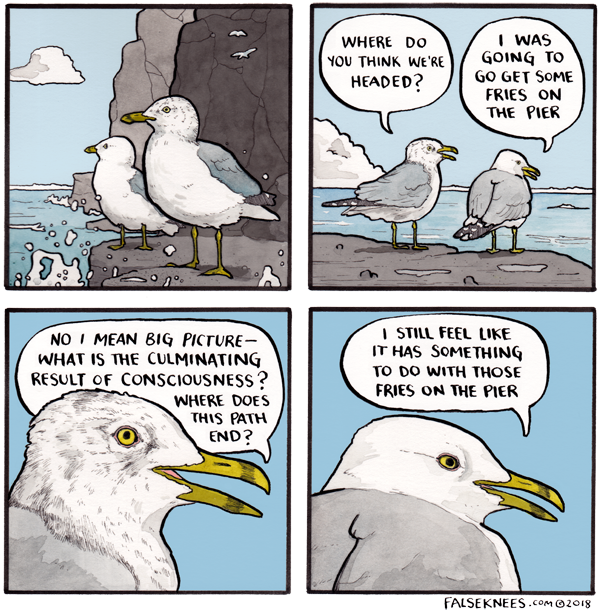
There is a comic that has circulated widely online, shown here: the first pigeon feels the unease of nothingness and questions the meaning of its existence, while the second offers a seemingly absurd answer. How are we to understand our being and nothingness? In Being and Nothingness, Sartre offers his existentialist explanation.
In fact, in the years before Sartre, scientific and technological revolutions had brought about the collapse of traditional beliefs and values, while world wars swept the world into modernity. Traditional philosophy seemed to leave little room for the human being. All these factors, and many others, brought about an unprecedented crisis of the human spirit: what is human existence? We urgently needed a theory of the human being to resolve this crisis, and existentialism arose in response. More precisely, perhaps existentialism would be better understood as a philosophy of living: its concern is the problem of how human beings exist and live.
II. Exploring Being
To understand what being is, we might begin with the structure of being in general.
1. Phenomena and Being
The phenomenological method reduces an existent to a series of appearances. It abandons the traditional Aristotelian metaphysical dualism that sets an existent’s inner essence against its outer appearance, holding instead that appearance is essence as it manifests itself, and that an object is simply the unified synthesis of its series of appearances. Yet a new dualism emerges: the finitude of our examination of appearances and the infinity of appearance itself seem to lead us back to the inner–outer dualism of appearance and essence. Here, however, appearance is no longer opposed to some other being. It indicates only itself and the entire series of appearances, and it has a being of its own; the being of this appearance will be the starting point of our exploration of being and nothingness.
If so, are the phenomenon of being and the being of the phenomenon still the same? In an individual object, we can always work back from concrete phenomena and qualities to an essence and constitute a whole—for example, arriving at the concept of a cake through its aroma. But being is not a quality of an object that we can grasp. We can only say that it exists: being is the condition of disclosure. This cake exists, and so I can come to know it. If, however, we treat being as an appearance that can be defined by a concept, our knowledge alone cannot provide a reason for its being (this is a concept we cannot grasp). The being of the phenomenon itself therefore cannot be reduced to the phenomenon of being.
2. Perceiving and Being Perceived
If a phenomenon exists as it appears, then the being of an appearance is its appearing—does to be mean to be perceived? What, then, grounds the being of our knowing (perceiving)? Husserl understands it this way: what is perceived refers back to the perceiver—to knowledge—and knowledge refers back to consciousness, ultimately forming a concrete concept of the whole. Yet when the knower takes themselves as the known in an act of self-knowledge, this leads to an infinite regress within the self. I cannot isolate myself in order to know myself. Consciousness must therefore be a direct, non-cognitive relation between the self and the self as an object.
Furthermore, reflective consciousness takes the consciousness reflected upon as its object. Conversely, positional consciousness of an object (which occupies consciousness) is at the same time non-positional consciousness of itself (without knowing that it is conscious). Thus, all conscious being exists as existing consciousness, and the being of which I am aware in myself is my consciousness. It follows that the potentiality of consciousness (its form of expression, such as joy) exists only as consciousness of that potentiality (that form of expression). Consciousness, then, cannot precede being: how could we be conscious of being joyful before we are joyful (when we are not yet aware of our joy)? Only afterward do we come to know the essence of joy.
Once we abandon the primacy of knowledge, then, we discover the being that knows: consciousness. Consciousness exists only as it appears to itself. It is a complete emptiness outside the material world, regarded as absolute because, within it, appearance and being are identical.
3. Consciousness and Being
Is the being of consciousness, then, sufficient to ground the being of appearances? Setting aside the idealist view, the being of what is perceived is relative to the being of the perceiver (relativity). It cannot be reduced to our consciousness; consciousness does not determine being. And the manner of being perceived is passive (passivity), both in relation to the action of the agent and in relation to the being of that which is acted upon. This does not, however, concern its being itself; otherwise, on entering our consciousness, it would fall into nothingness. Being, then, cannot be being-perceived; the being of consciousness cannot ground the being of the phenomenon. Even if someone closes their eyes, the cliff before them still exists.
Let us examine consciousness further: all consciousness is consciousness of something. Any attempt to make the being of phenomena depend on consciousness, however, will be futile. Objectivity cannot arise from subjectivity, and consciousness cannot step outside itself to posit an object. Otherwise, the object would become a nothingness confronting an absent consciousness. How could a nothingness outside the reality of the world posit something real within it? To say that consciousness is transcendence would be to acknowledge that “the being of consciousness as an object is being-perceived.” Yet transcendence is a constitutive structure of consciousness: from the outset, consciousness is supported by a being that is not itself. In terms of Heidegger’s “Dasein”: consciousness is a being whose own being is at issue in its being, insofar as that being implies a being other than itself.
At last, then, we have moved from appearances to being. Being haunts existents, and consciousness can transcend an existent, but not toward its being. Rather, it moves toward the meaning of that being (beyond the existent and toward ontology): the phenomenon of being, which discloses itself to consciousness and is what consciousness can apprehend. Following the discussion above, we divide being into two independent domains: the being of the phenomenon [being-in-itself] and the being of consciousness, as the pre-reflective cogito [being-for-itself]. Some properties of the being of the phenomenon, or being-in-itself, follow immediately:
First, this being is in-itself. Being is itself, beyond activity and passivity; it is an affirmation that cannot affirm itself, complete in itself. Second, this being is what it is. It is opaque and full, without negation, transcendence, or temporality. It is isolated in its being, sustaining no relations with other beings: an indissoluble synthesis of itself with itself. It does not return to itself as consciousness of self does; it simply is that self in its identity. Third, this being is. It can neither be derived from the possible nor subsumed under the necessary.
Having arrived at being-in-itself and being-for-itself from appearance, we will continue to explore what they mean.
III. The Problem of Nothingness
The key to resolving our questions about being is to describe the human being as a whole within the synthetic unity of the world (being-in-the-world). We ask: what is the synthetic relation of being-in-the-world? And what must the human being and the world be? To be honest, in asking such a series of questions, I have already admitted, in principle, the possibility of a negative answer. The pigeon at the beginning asks, “Where am I to fly?” This implies, at the very least, the non-being of its knowledge of its own direction, the possibility that this direction does not exist, and a non-being that limits the question (perhaps, for instance, the pigeon cannot fly at all).
In other words, “When questioning, the questioner is in a state of uncertainty: they do not know whether the answer will be affirmative or negative. The question thus becomes a bridge between two non-beings: the non-being of knowledge in the human being, and the possibility of non-being in transcendent being… Finally, the truth implicit in the question, as a differentiation of being, introduces a limiting non-being.” We have finally found our way into being, only to find ourselves surrounded by nothingness. These three non-beings condition being and complicate the problem.
1. Negation
What if negation were merely a concept belonging to judgment, supported by mental activity and unable to exist on its own, its being consisting precisely in its being-perceived (consciousness as an object)? And what if nothingness were the conceptual unity of various negative judgments, a structure of the real? In other words, between negation and nothingness, which is the origin and ground of the other?
In fact, negation is not a property of judgment. Questioning awaits the disclosure of being, and my question contains a certain pre-judgmental understanding of non-being, just as the pigeon’s does at the beginning. Suppose I deny the existence of a perpetual motion machine. Our negation arises because the object’s absence causes it to disappear as nothingness into a ground (the reflection of the surroundings in consciousness). Its absence becomes real, and the negative judgment we make at this point is conditioned and supported by non-being.
Does negation, then, emerge from what we expect of a question and what we actually find? If negation is our way of classifying and separating, then we would be casting into nothingness the being put forward through negation. In consciousness, negation is thus a sudden interruption of a continuous positivity. Consciousness cannot produce negation except by taking the form of a negative consciousness; negation cannot arise from being. The necessary condition of our negating is therefore that “non-being must continually appear within us and outside us: nothingness haunts being.” A new question now arises: where does nothingness come from?
2. Nothingness
From the perspective of Hegelian dialectics, being transcends itself toward essence; it is the immediate, the starting point of logic. Being and nothingness are merely opposing views (negative determinations). Hegel, however, takes for granted that abstractions must have some meaning in terms of being. In fact, non-being is the emptiness of being: being is, and non-being is not. How can we give meaning to something that does not exist? Nothingness is logically posterior to being. It must first presuppose being in order to negate it, selecting a contingency from undifferentiated possibilities to present being. That is to say, being precedes nothingness and provides its ground. Thus, when we say “nothingness haunts being,” it is because nothingness derives its being from being; the disappearance of being would mean the disappearance of nothingness.
Within phenomenology, being and nothingness can also be conceived as complementary in this way: in a sense, the real is a state of tension produced by the mutually exclusive forces of being and non-being. We often encounter attitudes that imply nothingness: hatred, suffering, regret. In everyday terms, we tend to understand them as the dissolution of some meaning or value. In particular, when we confront nothingness directly, what we feel is anguish, like the helpless anguish we feel before the future, failure, and so on.
Heidegger establishes the possibility of apprehending nothingness concretely, without granting being to non-being: nothingness is not; it nihilates itself, supported and conditioned by transcendence (a possibility of nothingness—the human being as “Dasein” effects a transcendence toward itself). “Human reality” emerges surrounded by being, and only in nothingness can being be transcended; “Dasein” (the human being) will realize the contingency of the world. Yet Heidegger has already made negation an original structure of transcendence, while nothingness is the ground of negation. A negative judgment would then lead “me” into nothingness and back to being, with reality partly in nothingness and partly in being (which again contradicts his own premise that nothingness is not). In fact, nothingness is supported by being and can nihilate only within the ground of being.
If nothingness is not outside being, cannot be conceived starting from being, and cannot be non-being (which would leave it unable to nihilate itself), where does it come from? Let us examine nothingness again: we can speak of it because it has an appearance of being, even if its being is conferred on it. There must therefore be a being that is not being-in-itself, one that can nihilate “nothingness” and bear it, through whose nothingness nothingness comes into the world. Let us return to the act of questioning: as questioner, the human being presupposes in the question a nihilating withdrawal from the given, and, as the cause of that withdrawal, also contains a nihilating withdrawal within themselves. Being thus detaches itself from possibilities, and indeterminate being is inscribed by negation. Various transcendent realities containing negativity (such as a distance that is not curved), because they originate in some activity of human being, directly mark the relation between human being and the world. In this way, the human being can make themselves known within the being in which they are situated.
Thus, the human being is the being through whom nothingness comes into the world. Human beings possess negativity, and therefore possibility. If so, what must the human being be in their being?
Human beings cannot eliminate being. They can only change their relation to it: place being outside their own sphere, so that it can no longer act upon them. At this point, the human being secretes a nothingness that makes them independent—Descartes calls this possibility freedom. What, then, must human freedom be, if the human being is the being through whom nothingness appears?
The process of nihilation must derive its source from itself alone. Nothingness is precisely the fissure between my successive mental states. In freedom, human being is its own past in the form of nihilation within consciousness, and likewise its own future as its possibility. The self exists by continually detaching itself from what is. It is precisely in this anguish before the past and the future that human beings become conscious of their freedom.
Human beings may therefore flee freedom, because it brings them face to face with nothingness, and so with fear and anguish. Like a slave suddenly freed, or subjects left without an emperor, what they first confront is the dissolution of the meaning of their past and future existence: nihilation.
In fact, what we often feel first is a direct apprehension of “the transcendent”: fear. Then, as we reflect and try to grasp possibilities—as we face freedom and confront nothingness—we feel anguish, until we transcend ourselves once again. In particular, consciousness of being is the being of consciousness (the being of fear is consciousness of fear itself).
But if anguish manifests freedom, why is it not more common?
Some say that value is what we ordinarily understand as meaning. In fact, value derives its being from its demand; once it is thought about, it is merely the concept of “value.” It reveals itself only to freedom. Freedom is therefore the sole ground of all values (and of the right to choose values), yet it has no ground of its own. Reflective freedom thus feels anguish before itself.
Nietzsche once said, “God is dead.” All traditional values have fallen apart under the deconstruction of nihilism; we ought to revalue all values. Indeed, no absolute values have ever existed. Most of the values and morals we accept are simply norms into which we were thrown at birth—what many people today like to call “discipline.” Yet in reshaping values, freedom feels anguish. Nothing ever supports me against myself; I make my decisions without anything to justify me.
Psychological determinists believe that there is a force in us that counters anguish and drives us to act, defining the human being as an isolated being that is what it is. Yet this evades the self-evidence of human freedom and stifles what we call individual agency: determinism cannot dispel our anguish. Likewise, attempts to conceal anguish fail in the contradiction that, in order not to think about it, we must keep thinking about it: our consciousness is anguish. Moreover, fleeing anguish also means eliminating the threat of the past. Although it supports my essence, I still refuse to be defined by my past; I want to transcend the self that is past, the self that already was. A new attitude thus presents itself to us, a capacity to nihilate within anguish: bad faith. I should point out that “self-deception,” the Chinese term used here, carries no pejorative meaning in this context. A literal translation of the original term would be “bad belief”; to my mind, it seems more like belief that is not essential.
What, then, must consciousness be for the human being—the being through whom nothingness comes into the world—to be capable of bad faith (the unity of being and non-being within consciousness)?
3. Bad Faith
In other words, human being can adopt a negative attitude toward itself, an attitude we call “bad faith.” What must the human being be in their being for bad faith to be possible?
Let us first consider the relation between bad faith and lying. A liar knows the truth. The negated object of a lie is a nonexistent transcendence of the truth. There is a duality here: the liar denies the truth before others, while denying this denial of the truth before themselves. There is also the duality of the liar and the other person. If bad faith is lying to oneself, however, these dualities disappear. How can I simultaneously believe the truth and its negation? Consciousness will be uneasy about bad faith, even as we believe what bad faith tells us. Bad faith in fact oscillates between the sincerity of being what one is and a cynical deception of oneself. Even if, as psychoanalysts suggest, the unconscious governs “me” through the agency of an unconscious repressing force, thereby establishing an active consciousness of bad faith, this would still break the unity of the psyche and could not apply universally.
Back where we started, let us turn to acts of bad faith. When a student studies, they have expectations about grades—transcendence—and also pursue knowledge—facticity. The former is not what it is; the latter is what it is. The human being is a synthesis of contradictions. The identity of being what one is is not the constitutive principle of human reality: human reality must be what it is not. Imagine that, in the sense of being, a person were what they are as being-in-itself. Their existence would then serve to realize their being (as with an identity enacted through social “rites,” or even an excessive propriety of bearing). Like a robot executing code, they would be mechanically turned into a thing. Nowhere could they transcend themselves. They could exist only as the subject of definitions and labels, forever confined within them.
The preceding discussion, however, concerns the human mode of being. As for an object that my consciousness becomes, such as sadness, I still am this sadness in the mode of being what it is: consciousness of being is the being of consciousness. Consciousness exists because it brings itself into being. Within subjectivity, it sustains being (for example, consciousness of sadness) and is occupied by being, yet it is not that being (consciousness itself is not consciousness of sadness): consciousness is not what it is.
The meaning of sincerity—being what one is—thus contradicts the structure of my consciousness. No sooner has our consciousness posited itself as a certain being than it demands that we transcend that being, that we not be what we are, just as one can never step into the same river twice. If we insist on defining ourselves as the past self that I was but no longer am, or demand that someone being criticized first be what they are in order to cease being what they are (which would turn their freedom into a thing and define it), then sincerity becomes bad faith! Human being eludes all definitions; we can never know ourselves. Sartre thus points out: “What matters is to establish human reality, in bad faith, as a being that is what it is not and is not what it is.” Perhaps sincerity and bad faith are not so different after all.
Sincerity aims to make me be what I am so that I coincide with my being: “to be what I ought to be in the mode of the in-itself.” Bad faith aims to make me be what I am in the mode of “not being what I am.” It tells you: why must you be yourself? For bad faith to be possible, sincerity recognizes that it fundamentally has no end, and thus becomes bad faith; otherwise, I could not deny my opposite in order to define myself (to be what I am not). Thus, for human reality to be capable of bad faith, “in its most immediate being, in the inner structure of the pre-reflective cogito, it is what it is not and is not what it is”—contradicting itself and eluding itself.
The ugly duckling is, in essence, a white swan, but it is in bad faith: it believes that it is not a white swan, only an ugly duckling. Yet even if it truly becomes a white swan, something of the ugly duckling will remain within it, although it is no longer an ugly duckling.
Bad faith, then, is belief, rather than a cynical act of lying to oneself. But how can people believe, in bad faith, in concepts they have invented? In fact, from the moment the project of bad faith emerges, a person’s entire view of the world is already in bad faith.
To believe is to know that one believes; and once one knows that one believes, one no longer believes. Consciousness of belief makes belief into a concept that can be grasped, thereby destroying it. Reflection here gives us the right to negate and nihilate. Belief thus puts itself in question in its very being, appearing in a negation that destroys it. In this sense, bad faith cannot believe what it is supposed to believe; it seeks only to flee what we are, which we cannot flee. This project of flight reveals a split within being, and bad faith consists precisely in this split (hence being what it is not and not being what it is). Clearly, bad faith will deny that it is bad faith; otherwise, it would destroy itself.
We therefore enter bad faith as though falling asleep, and are in bad faith as though dreaming. The possibility of waking lies only in non-belief being the structure of belief. Bad faith can even be the ordinary face of life: a warrior overcoming their natural cowardice, a lover burying their longing for a first love. Yet the nature of bad faith makes it a permanent threat to human being. Consciousness runs the risk of bad faith in its very being: “In its being, consciousness is what it is not and, at the same time, is what it is.”
IV. Being-for-Itself
1. Consciousness
What does it mean for consciousness to be what it is not and not be what it is? How can we explore the cogito within the being of the cogito? Consciousness reflecting on being does not wholly coincide with itself: consciousness is a “decompression” of being. The reflective gaze changes the consciousness toward which it is directed. For example, much like belief, faith cannot exist before we are conscious of it, and it can exist only as faith that has been disturbed: from the outset, its being is a flight from itself, beyond our grasp.
We should return to pre-reflective consciousness: consciousness of self (the cogito). The self, however, is not the subject. Coincidence with the self would make the self disappear, replaced by whatever “coincides” with it. In view of this difference, we say that the self represents an ideal distance within the subject’s immanence in relation to itself, a way of “continually maintaining an unstable balance between identity and the synthetic unity of multiplicity”: presence to self. Being’s presence to self, in turn, implies a separation between being and self. Thus, presence to self posits an impalpable fissure that has slipped into being. This fissure is a pure negative: nothingness. It can exist only when we do not see it, and can nihilate any totality. Yet the nothingness that emerges from consciousness does not exist; its being is conferred on it. The for-itself must therefore be its own nothingness, constituted as human being. Nothingness comes into being through the particular being that is human reality, yet continues to be sustained by being. Only this nothingness can produce being (being-in-itself is isolated).
If being is by virtue of its contingency, why is this being this way rather than that? Because it exists in the world, and there is something within it of which it is not the ground. If being were its own ground, it could only be what it conceived itself to be. But this is the cogito: a being that is not its own ground apprehending its contingency. As for why we can exist in “the unity of one and the same upsurge of being”—that is, “how the for-itself becomes the ground of its own nothingness”—the answer lies in two things. When being grounds its own nothingness, the being thus grounded is nihilated, giving rise to the notion of contingency. There is also the possibility that the necessity of being cannot escape. In a word: being is contingent.
The being of consciousness, then, is contingent. It exists in-itself in order to nihilate itself into the for-itself, and cannot find its explanation or ground in a necessary being (which marks a desire to establish its ground). “The possibility of being revealed in the act of nihilation is that of becoming the ground of the self; the for-itself is the in-itself that disappears as in-itself in order to be founded as consciousness.” The in-itself cannot ground itself. If it did, it would undergo the transformation into the for-itself, becoming its own ground. Grounding in general thus comes into the world through the for-itself. The for-itself is sustained by an ongoing contingency and arises as a particular consciousness; this is what we call facticity.
In a concrete situation, when I constitute myself as the ground of my being, I have not chosen my position (being born into a certain identity). This makes me consider myself wholly responsible for my being, yet I will give meaning to my facticity and resist it; it will be the mark of being that I give myself in order to become what I am. The for-itself arises as consciousness of “being-here,” and the motives it discovers within itself are conveyed by its facticity. Thus, the for-itself is for-itself: it is its own ground.
2. Value
What, then, does this description of the for-itself reveal to us about the cogito?
Being-for-itself is uneasy about nihilation in its being, and so, to sustain nihilation, it must define itself as a lack of being. It determines itself as not being the in-itself, yet grounds itself by starting from and relating to the in-itself, using it as its raw material. Nihilation is therefore the nihilation of being. Here Sartre identifies a negation that “penetrates most deeply into being”: “a negation that, in its being, constitutes the being through which it denies and the being that it denies. We call this lack (somewhat like the internal relation of the unity of opposites in a contradiction)… It presupposes a trinity: that which is missing, or the lacking; that which is missing what is lacking, or the existing; and a totality that is broken up by lack and restored by the synthesis of the lacking and the existing: the lacked.” The full moon gives the crescent moon its being as a crescent. What is not determines what is; the being of the lacking is established by the lacked and, in the being of the existing, tends beyond itself (here we catch a glimpse of transcendence).
Likewise, lack can come from being only through a being that lacks: through human reality, this lack that transcends being. For example, my desire is not that which produces it, and it is haunted by the being that it desires. The existing thus appears as the immediacy with which desire presents itself to the cogito (consciousness of desire), while the for-itself, as its own ground, is the upsurge of negation, continually negating being-in-itself. In fact, the for-itself has meaning only when it faces a being that grounds its being and no longer merely its nothingness. That is, the cogito turns back toward what it lacks and what lacks it: human reality is its own transcendence toward that which lacks it. This is the origin of transcendence, except that human reality can never reach the in-itself.
The whole thus constituted is consciousness itself, yet consciousness is not this whole; it merely sustains itself in its mode. The whole seals within itself the incompatible, contradictory characteristics of the in-itself and the for-itself. These contradictions even lead people readily to create this whole as a being outside the world, a transcendence made into an entity: God (the ground of the world). In particular, this whole does not appear to consciousness in isolation. It is present to a concrete consciousness, haunted by the absent being that is the self, and therefore cannot be fully grasped: “My real suffering can become suffering only as my consciousness.”
Now, at last, we can clearly define the being of the self: value. Value has no being as a reality; it comes into the world through human reality as a structure of consciousness. A being then transcends its own being toward value (the activity of conferring value will detach it from its being), so value is the unity of the transcendence of being. Yet the fundamental value of this transcendent being is in fact posited by my a priori transcendence (where else could value come from?) [But the argument here seems overly metaphysical, somewhat beyond our reason; perhaps my understanding is simply too shallow]. Value is therefore the self. It haunts the for-itself, haunts the being that grounds itself (as the ground of its nihilation), haunts freedom. It is the being that the self ought to be.
This is how we seem to exist for the sake of value. Whether through the tide of relentless competition or the alienation of capital, the modern world keeps trying to define the “self” through manufactured values, haunting our being. Yet when we are merely conscious of the for-itself’s consciousness of “being-in-the-world,” we are only conscious of our own being-for-itself as nihilation; we have not recognized value. The for-itself haunted by value must be reflected upon. From it, we must draw out the value that the self is, along with the meaning of the transcendence that I, as a being that lacks, cannot truly attain: a being-in-itself, full within itself.
3. Possibility
To become a self, the for-itself must form a whole in an assimilating synthesis with what it lacks. What emerges on the basis of the nihilation of the for-itself is the possible of the for-itself. Human reality both is and is not its own possibilities (the moment it is them, it no longer is them). For the human being, when I exist as the right to be what I am, rather than as being what I am, there are possibilities to choose from, and this contains an element of the for-itself. Being-in-itself also needs a being that faces possibilities—the human being—in order to establish relations. We determine “ourselves,” although I can never truly describe my being.
Every for-itself is thus the lack of a certain coincidence with itself. It is “presence to self” (and lacks a certain “presence to self”), and this lack comes from within the totality of consciousness. When this for-itself realizes value as a fulfilled being and gives value being-in-itself, what this for-itself lacks is the possible (the for-itself is realized and becomes full in its synthetic assimilation with the possible). Thus, “the possible is what the for-itself lacks in order to become a self.”
It should be pointed out that all the preceding exploration has taken place within the circle of solipsism. We have discussed only the being and nothingness of the “I,” leaving temporality and the Other aside.
V. Closing Thoughts
“I” here is only a pronoun.
Lu Xun once wrote: I am about to speak, and at the same time I feel empty. Sometimes, as soon as I try to explain something, what seemed complete within my consciousness begins to dissolve into nothingness. In my consciousness, its being is no longer what it is, and everything that seemed necessarily valid seems no longer necessarily so.
So I try to disbelieve those traditions, morals, values, and forms of discipline that seem to be the way things ought to be; the currents in society that people flock toward; the things people take for granted that they should do; even my understanding of my own existence as an “I.” Through nihilation, I negate and dissolve them. At this point, I find that they do not seem to exist as I once thought they did. All I can feel is nothingness, the consciousness of the cogito, and anguish before nothingness. Life seems meaningless, and so, like that pigeon, I ask: where am I to fly?
When the for-itself is the nihilation of the in-itself, I exist as the synthesis that links the in-itself and the for-itself: the human being is precisely the being through whom nothingness comes into the world.
Such questioning is inevitable, because my being is always fleeing itself, always changing, always being what it is not and not being what it is. Yet the nothingness inherent in the structure of my consciousness means that I can never “rest in the highest good.” I can only be tormented by the predicament of being unable to know myself, moving slowly among possibilities toward that “complete” self, never reaching that transcendent self. My existence precedes the essence that will come to be known; I will not be turned into a thing as essence, as being-in-itself. I exist, but not as the essence of the self that I am. I am in bad faith, living by meanings and values that I have “made up.”
Even if, one day, through questioning and reflection, you truly “find” the meaning of your existence—that you ought to exist according to this essence—will you gladly accept it? No. You will only nihilate it once again, continuing to exist in the way you are what you are not and are not what you are.
But when I am uneasy and anguished before nothingness, freedom reveals itself to me. I still have freedom—freedom with this capacity for nihilation—and I still have facticity, the facticity that sustains my being-for-itself. Countless possibilities open before me. I can cry when I want to cry, laugh when I want to laugh. I have the right to choose. I am my own God, even if only a useless passion.
Where does that pigeon want to fly?